

.svg)










%20(2).webp)
Why Artificial Intelligence is the “New English”
1. Introduction: The Shock of Speed
The world witnessed a phenomenon unprecedented in the history of technology: ChatGPT reached 1 million usersin just 5 days.
To get a better perspective, the 100 million user mark was reached in just two months, a record that surpassed decades of digital adoption metrics.
This jump generated an immediate paradox: while many more traditional schools try to ban this tool, for fear of plagiarism or an eventual “cognitive deception”, the labor market has already irreversibly integrated it into their daily lives.
As a digital literacy strategist, my goal is clear: to analyze how Artificial Intelligence (AI) is redefining the way we learn for the generation that will lead the world in 2035.
2. From Survival to Creation
AI literacy is not just about “using applications”.
It involves, above all, the transition from a passive consumer of algorithms to an active creator of solutions. The mission of SHARKCODERS is precisely that: to empower the new generation to create their own technology and, with that, reach their full potential.
⚠️ Use without guidance
Without guidance, AI can be used to copy work, avoid cognitive strain and create a technological dependency that compromises the development of critical thinking.
✅ Use with guidance
With guidance, AI becomes a true co-pilot of innovation.
Allows you to speed up processes, boost creativity, master the machine through prompt engineering and develop more rigorous critical filters
“AI is not going to replace people. People who use AI will stand out against those who don't.” - SHARKCODERS
3. The Swiss Model
In primary schools in Menzingen, Switzerland, 10-year-olds already treat ChatGPT as “you”. The pedagogical objective is not to get the right answer, but to learn to interact with the logic of the machine.
In a language exercise, students challenge AI to create riddles about their own personality.
The Swiss approach sees the ban as a pedagogical error. The focus is, above all, on the formation of a critical spirit.
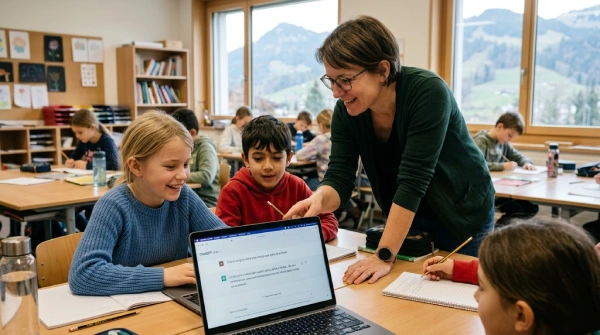
When the AI fails, as in the real case where it identified a student as being a dog, just because he mentioned that he liked animals, the teacher intervenes with the essential question: “You have to ask yourself if it's the right thing to do.” The machine error thus becomes one of the most valuable learning moments in the classroom
4. The “Hallucination” and the Danger of the “Reverse Centaur”
It is vital that parents and educators understand that language models are statistical processors, not rational beings. These systems predict the next word based on probabilities, which can give rise to hallucination phenomenon.
We have already seen AI suggest putting “glue on pizza” for cheese to stretch or even claim that it is safe to “eat stones”.
If we blindly accept these results, we fall into what the scientist Átila Iamarino describes as the “Reverse Centaur”. In this dystopia, the machine makes the decisions and the human becomes a mere executor, busy only correcting the errors of the algorithm, without real creative control.
The true learning process in 2035 will be able to review, question and correct the machine, and not in the passive acceptance of their “hallucinations”, however coherent they may seem.
5. The “End of the Middle” and the Cure for the Disease of Costs
Lia Glass, from the Telefónica Foundation, recalls the analogy of American fighter cockpits: designed for an “average pilot”, they ended up causing accidents because that pilot, statistically, did not exist.
Traditional education often makes the same mistake when teaching for the average.
This is where the economic dimension comes in. The Baumol Effect, also known as Cost Disease, explains why human services, such as education, become progressively more expensive: their productivity does not scale at the same rate as that of a microprocessor.
Sharky AI — Personal Tutor
This personal AI tutor allows for hyper-personalization of learning, offering 1-to-1 attention that, until now, was economically impossible to scale. AI does not replace the teacher; on the contrary, it frees him to assume a more strategic, human and guiding role
.webp)
6. The Labour Market in 2030
The World Economic Forum's (WEF) Future of Jobs Report 2025 functions as a map to understand the reality of 2035. Projections indicate that, by 2030, technology could create 170 million new functions, while 92 million could disappear.
Skills that AI cannot replicate
- Analytical and Critical Thinking- Distinguish what is true.
- Resilience, Flexibility and Agility- Constantly relearn tools.
- Leadership and Collaboration- Manage emotional intelligence and hybrid teams.
7. Conclusion: Preparing for 2035 starts now
The pedagogical transition of SHARKCODERS, based on the WAVE Methodology, marks the transition from teaching “syntax”, writing line by line, to the teaching of architecture and logic.
Thanks to AI, a student can now create a complex 3D game in just 2 weeks, a task that previously could require 2 months of exhaustive manual code. AI removes the technical barrier of frustration and allows the child to focus on what really matters: solving real problems
If the human brain has not changed significantly in the last thousand years, but our tools have changed dramatically in just two centuries, then the question that is imposed on parents is inevitable:
Are we educating our children to be pilots of these machines or mere passengers of the algorithm?

.webp)

.webp)
.webp)
.webp)

%20(1)%20(1).webp)
.svg)
.svg)


